
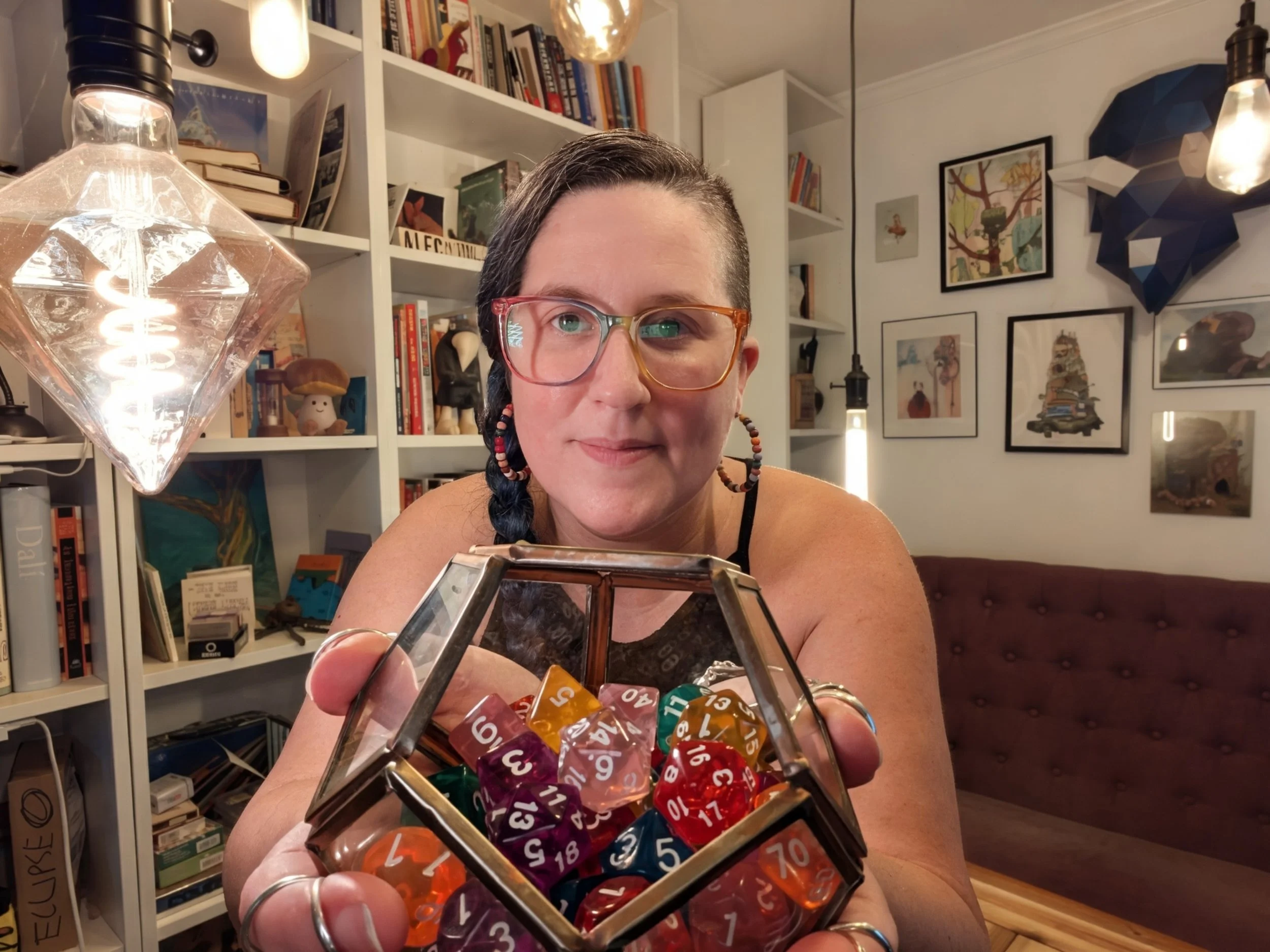
D&D-based Peer Support Groups
Welcome, exhausted travelers!
Are you feeling burnt out by the Spoonie life, or struggling to budget your limited energy?
Are you looking for low-energy ways to recharge more effectively?
Do you ever wish you had friends who better understood how hard your day-to-day life is?
Do you wish you could learn D&D, but worry your ADHD/brain fog/math skills will slow the game down and annoy others?
If any of these apply, you may be a good fit for one of my upcoming virtual D&D-based peer support groups! Within this circle, you can escape reality for a bit, harvest some dopamine, find community with folks who really understand your struggles, and build a rewarding hobby to enjoy for years to come. Those interested can even learn how to run their own games as a DM (“Dungeon Master”)!
“But I can’t possibly do that!” you object. “I’m bad at math, and I forget things constantly…”
Me too! Which is why I won’t get annoyed even if you ask me how your weapon/spell works EVERY SINGLE TURN. Seriously! There will also be written summaries, visual aids, automated/outsourced math, simplified tech, and multiple safety tools. Furthermore, the D&D rules themselves can be either slightly or dramatically simplified to fit each group’s needs, or even each individual’s needs!
“But I’ve had some bad experiences with D&D groups online…”
Yeah, me too. I’m sorry that happened. I’ve seen a lot of DMs with anger and/or control issues, as well as all-male groups that get aggro at the drop of a hat. That’s one reason I started these groups; to provide a safe and mental-health-conscious environment for new players to learn without fear of being hazed! Tabletop Roleplaying Games can be a deeply rewarding hobby for introverts and extroverts alike, and I want to make them accessible to everyone.
And while I hope to make these groups an ongoing resource, I also hope that some of you will learn to DM yourselves, so that you can run your own games (maybe even with some new friends from group!) I’ll be happy to provide peeks “behind the DM screen” for anyone interested in managing their own dungeons.
Target Audience
My target audience is adults with chronic energy issues. In practice, most members are experiencing one or both of the following:
a chronic illness or condition that drains or limits their energy (e.g. hEDS/POTS, migraine, fibromyalgia, ME/CFS, long COVID, chronic pain, chronic depression/anxiety, insomnia, burnout, etc.)
Neurodivergence that drains or limits their energy (e.g. diagnosed OR suspected ADHD or Autism, sensory processing differences, HSPs, etc.)
The focus of the groups will be on peer support, building energy-management and coping skills, finding sustainable self-care/recharging strategies, and resource-sharing. As a structured activity with clear rules and safety tools, D&D can also be a great context for some folks (e.g. some Autistics, folks with social anxiety, and deep introverts) to get to know each other in a gradual, low-stakes, natural-feeling way. It’s basically the opposite of speed dating… Should we call it “slow friending,” maybe?
[Note: unlike in most therapy groups, participants in this support group will be free to offer friendship to other participants, though there will be some ground rules.]
Structure
These groups combine a lightly-psychoeducational D&D game (for 1-2 hours) with a more traditional support group format (for 30-60 minutes) for a total of 2-3 hours, depending on the needs of each group. Groups will be relatively small (aiming for 4-7 players per session) and I’m offering at least one reduced fee slot per group.
Each D&D campaign can be customized to fit the needs and goals of each group, including timing, length, and frequency, as well as story elements and challenges designed specifically for each player’s character, and for the group’s needs as a whole. These campaigns are generally rich in roleplay and problem-solving, and may be very low-combat in groups that prefer this. Safety is heavily prioritized, and multiple safety tools will be available. Relational aggression will not be tolerated, though direct communication is welcome.
Folks who wish to play every D&D session may book ahead as far as desired to reserve their spot in the group, and can expect their character’s backstory, traits, and goals to be carefully woven into the story. Players who can’t (or don’t wish to) attend on a regular basis may also choose to join the “drop in” list, to be notified of single-session openings as they arise, sometimes at a discount! (Please note: drop-in players’ characters may be less thoroughly integrated into the larger story, as these openings may be both last-minute and temporary.)
Character design
If designing your first PC (player character) feels intimidating or overwhelming, don’t worry; I’m here to help as much as needed! Everyone who joins a group will also be given access to my library of D&D manuals via DnDBeyond.com, to peruse their character options in the Player’s Handbook at their leisure.
Those who want guidance may reach out via email or text, or may request a 1:1 character-design consultation (currently free), wherein I walk you through the whole process, and help you identify the best class, subclass, species, and background for your needs/wants as a player.
If that sounds like too much work, you can instead choose a premade character (one I’ve already optimized for the campaign). Or I can design a custom character for you, based on what sounds fun to you, and suited to your desired level of play complexity.
How to apply
Just click the button below to apply (with no obligation), or go ahead and schedule your free consultation! You don’t need to know anything about D&D to join, as I’ll be teaching the rules as we go, and adapting the rules-burden to fit each group’s needs.
Before being accepted into the group, you’ll be asked to participate in a free consultation with me (via video, phone, or email; your choice) to ensure you’re a good fit for a current or upcoming group, and to discuss your hopes for the group. Depending upon the number of applicants versus openings, you may be offered a spot in an existing or upcoming group, or you may be placed on a wait list for future group openings.
FAQs
Is it too late to join?
Nope! These groups are open, meaning members can join after they launch. Even if the group you’re interested in is currently full, you can still join via the drop-in list! You’ll still need to complete a free consultation and create (or choose) a character before you can jump in, though.
Do I need a diagnosis to be eligible?
No diagnosis is required to join this group! If you have a perpetually low battery or chronic energy management issues (including burnout) and suspect you’re neurodivergent (e.g. ADHD, Autism) or chronically ill (e.g. POTS, Long COVID, ME/CFS, MS, undiagnosed mystery condition, etc.) this group was designed for you. Honestly, it’s the group I wish I’d had before I was diagnosed.
Many applicants think they’re “not bad enough off” to merit a place in a support group, but if the idea of learning from this community sounds helpful to you, you’re probably already a good candidate! There is no competition or award for “Queen of Burnout”; everyone’s suffering is valid and worthy of support here.
There will be folks with varying support needs and/or “spiky profiles” in these groups, and a variety of cognitive and/or physical disabilities and/or learning/sensory differences. There will be Autistic folks who may or may not mask, and whose facial expression and/or tone of voice might appear flat, or might be misinterpreted by some as negative or disengaged. There will be ADHDers who talk too long or too fast, or go on tangents, and who may need to be politely interrupted with a raised hand. We will be accommodating a bunch of misfits, so if that doesn’t sound good to you, this group may not be the best fit!
Do I need any D&D experience? Or Books, dice, etc.? Or a gaming computer?
Absolutely not!
Firstly, any written references you might need should be in the Player’s Handbook (PHB), which you’ll have digital access to through the DnDBeyond website and app once you’ve joined either campaign there. The PHB covers most rules and character options, though you certainly don’t need to read it to play. Most of the relevant rules will be included in handy pop-ups or sub-menus on your digital character sheet, and the rest I can look up for you as needed. So you don’t need to buy the books or memorize anything.
You will need a computer and internet that can handle 6-8-person video calls, but I intentionally chose the simplest and lowest-demand browser-based VTTs (Virtual Tabletop programs) to accommodate differing levels of brain fog, computer knowledge, income (not everyone can afford a gaming PC!) and internet speed. If you’re worried about your computer or your internet speed, we can test it out during our Session Zero by opening all the relevant programs at once.
Why isn’t this group free for everyone???
I frequently get asked why I don't just run this group for free, or offer unlimited reduced-fee slots. And I get it! The economy is hard. Everyone's looking for ways to save money. So I'm happy to be transparent.
Believe it or not, this group isn't even designed to be profitable for me. If I had a full group who all paid my full fee and never cancelled, I might make as much as I would have if I'd instead spent those group hours at my day job (as a therapist). But that only includes the 2-3 hours of each group, a small fraction of the time/money actually spent.
It excludes the hours I spend every week prepping and customizing the campaigns to better fit each group and player, as well as the 2+ years I spent researching and creating this world, and the 18 months of games I ran (and continue to run) to playtest it and develop it further. It also excludes the months of paid trainings I took on how to run TTRPGs in ways that support mental health, the advertising costs to recruit and keep the groups full, and of course the years and student loans it took to gain the education, professional skills, and experience that help me lead safe and effective support groups.
Even if we ignore all those unpaid hours and costs though, breaking even for those 2-3 hours would still be unlikely. Due to the populations I serve (including folks with chronic illnesses and/or ADHD), I expect frequent cancellations and some drop-outs. The reduced-fee slots I'm offering will further cut my income, as will the discounted slots I offer through the drop-in list.
So what is my goal, if not to increase profitability? My goal is to make these groups sustainable, so I can manage my energy and avoid burnout (what the group itself is all about!) and so I can continue to be a resource for this community for years to come. If you also want these groups to stick around long-term (and to remain financially accessible), please consider supporting that goal with one or more of the following actions:
Share this group within your social circles! You probably know some eligible folks, even if you don’t know it yet (we're sometimes invisible). Even if your group is full, another group might have room, and I’m always recruiting substitute players! I can accept folks anywhere in the U.S.
Attend regularly
Join the drop-in list (this helps even if you only ever take discounted or free slots!) If you’re in one group, you’re more than welcome to join the drop in list for another group.
Pay the standard fee (if you can afford it)
Pay a partial fee (if you can afford it)
I’m ScarED!
That’s not a question, but it *is* normal! D&D sounds way more complicated than it is, and it’s a highly adaptive game. We’ll be simplifying some rules and ignoring others to co-create a game that fits our group’s specific needs.